Why does the decimal point "move" when you multiply by 10?
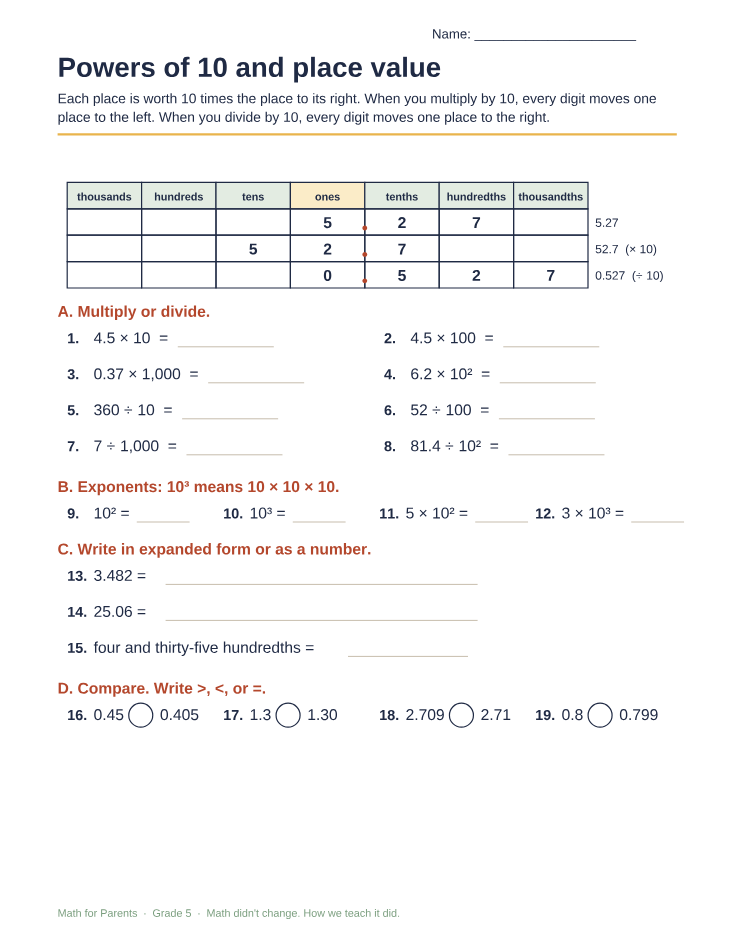
When you multiply by 10, every digit moves one place to the left on a place value chart, because each place is worth 10 times the place to its right. Dividing by 10 moves every digit one place to the right. The decimal point stays where it is.

How you probably learned it
You probably learned "to multiply by 10, move the decimal point one place to the right", or "just add a zero".
How your kid is learning it
Your kid learns why it works: the digits move, not the decimal point. In 5.27 × 10, the 5 moves from the ones place to the tens place, so the answer is 52.7. "Add a zero" stops working with decimals (5.27 × 10 is not 5.270), which is why schools avoid it.
Powers of 10 and exponents
10² ("ten squared") means 10 × 10 = 100. 10³ means 10 × 10 × 10 = 1,000. The small raised number says how many 10s are multiplied, and also how many places the digits move: 6.2 × 10² = 620.
Reading and comparing decimals
The same chart helps with comparing. Is 0.45 bigger than 0.405? Line them up by place: both have 4 tenths, but 0.45 has 5 hundredths and 0.405 has 0. So 0.45 is bigger, even though 0.405 has more digits.