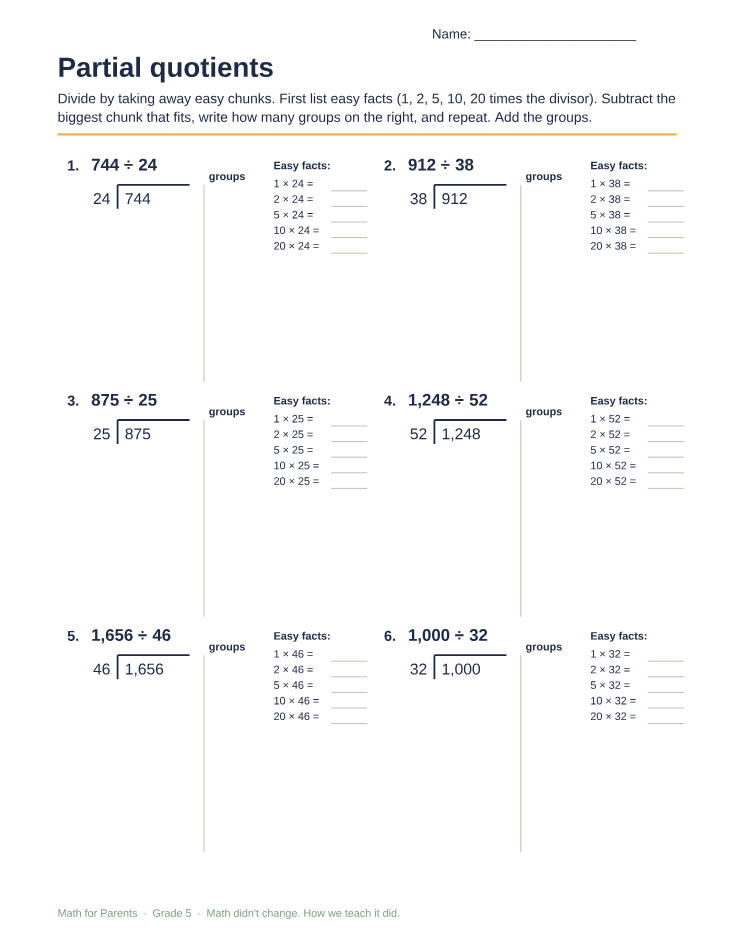
What is the partial quotients method for division?
Partial quotients is a way to divide by taking away easy chunks, like 10 or 20 groups of the divisor at a time, and keeping track of how many groups you took. Add up the groups at the end, and that is the answer.

How you probably learned it
You learned long division: divide, multiply, subtract, bring down, and repeat, one digit at a time, with every digit having to be exactly right.
How your kid is learning it
Your kid can take away any chunk that fits, even if it is not the biggest one. For 744 ÷ 24 they might take away 20 groups (480), then 10 groups (240), then 1 group (24): 20 + 10 + 1 = 31.
Start with a list of easy facts
Before dividing, kids write down 1, 2, 5, 10, and 20 times the divisor. For 24 that is 24, 48, 120, 240, and 480. Now they never have to guess at a hard multiplication fact.
Why teachers like it
With long division, one wrong guess means erasing. With partial quotients, a small chunk is never wrong, it just takes an extra step. Kids also see what division really asks: how many groups of 24 fit in 744?
Remainders
If something is left over that is smaller than the divisor, that is the remainder. 1,000 ÷ 32 = 31 with 8 left over, written 31 R 8.