What is GEMS in math? (Order of operations)
The order of operations is the agreed order for working out a math problem: grouping symbols first, then exponents, then multiplication and division, then addition and subtraction. Many schools now teach it as GEMS instead of PEMDAS.

How you probably learned it
You probably learned PEMDAS ("Please Excuse My Dear Aunt Sally"): parentheses, exponents, multiplication, division, addition, subtraction.
How your kid is learning it
Your kid may learn GEMS: grouping symbols, exponents, multiplication and division, subtraction and addition. Same rules, but it fixes a common PEMDAS mix-up. Multiplication and division are a pair, done left to right, and so are addition and subtraction.
Why PEMDAS trips kids up
PEMDAS lists M before D, so many kids think every multiplication comes first. But in 12 ÷ 3 × 2, you go left to right: 12 ÷ 3 = 4, then 4 × 2 = 8. Doing the multiplication first gives 2, which is wrong.
Brackets and braces
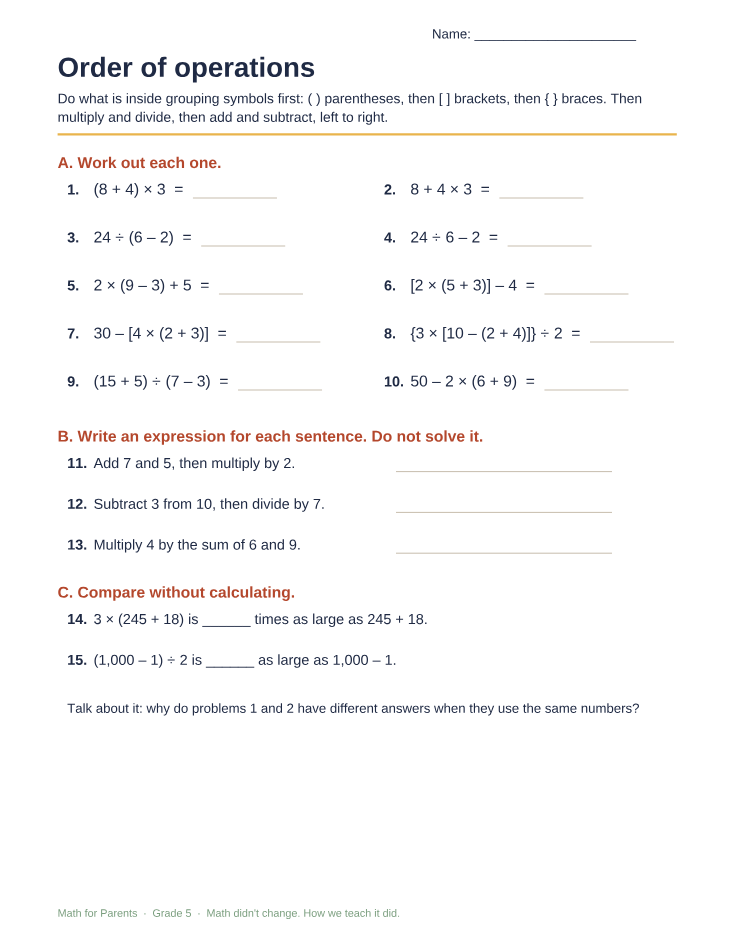
In 5th grade, kids see more than parentheses. Brackets [ ] and braces { } are bigger grouping symbols. Work from the inside out: parentheses, then brackets, then braces.
For example, {3 × [10 − (2 + 4)]} ÷ 2: first 2 + 4 = 6, then 10 − 6 = 4, then 3 × 4 = 12, then 12 ÷ 2 = 6.
Reading expressions without solving them
5th graders also learn to read an expression like a sentence. 3 × (18 + 9) means "three times as much as 18 + 9". They should be able to say that without working it out.