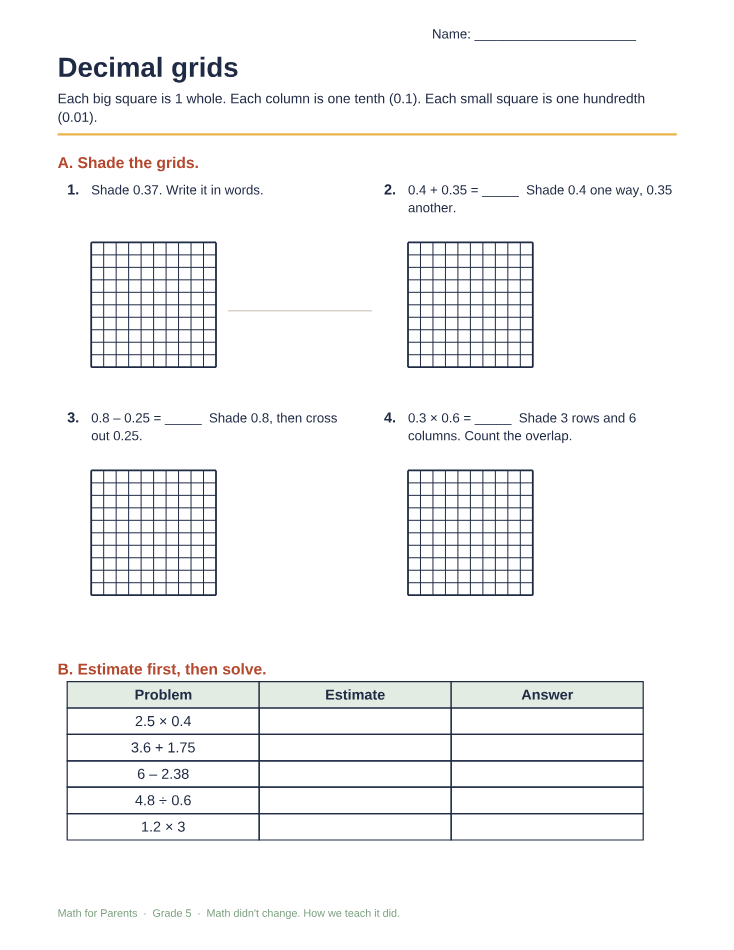
How do decimal grids (hundredths grids) work?
A decimal grid is a 10-by-10 square that stands for 1 whole. Each column is one tenth (0.1) and each small square is one hundredth (0.01). Kids shade squares to see decimals and to add, subtract, and multiply them.

How you probably learned it
You learned to line up the decimal points to add and subtract, and to count decimal places to multiply.
How your kid is learning it
Your kid shades a grid first. 0.4 + 0.35 is 4 columns plus 35 squares, which fills 75 squares: 0.75. 0.3 × 0.6 is where 3 rows and 6 columns overlap: 18 squares, or 0.18.
Why multiplying decimals can make smaller numbers
Kids are often surprised that 0.3 × 0.6 is smaller than both numbers. The grid shows why: you are taking part of a part. Three tenths of six tenths is a small corner of the whole.
Estimate first
5th graders are taught to estimate before they calculate. 2.5 × 0.4 is between 2 × 0.4 and 3 × 0.4, so the answer should be around 1. If they get 10 or 0.1, they know to check.