How do you add fractions with different denominators?
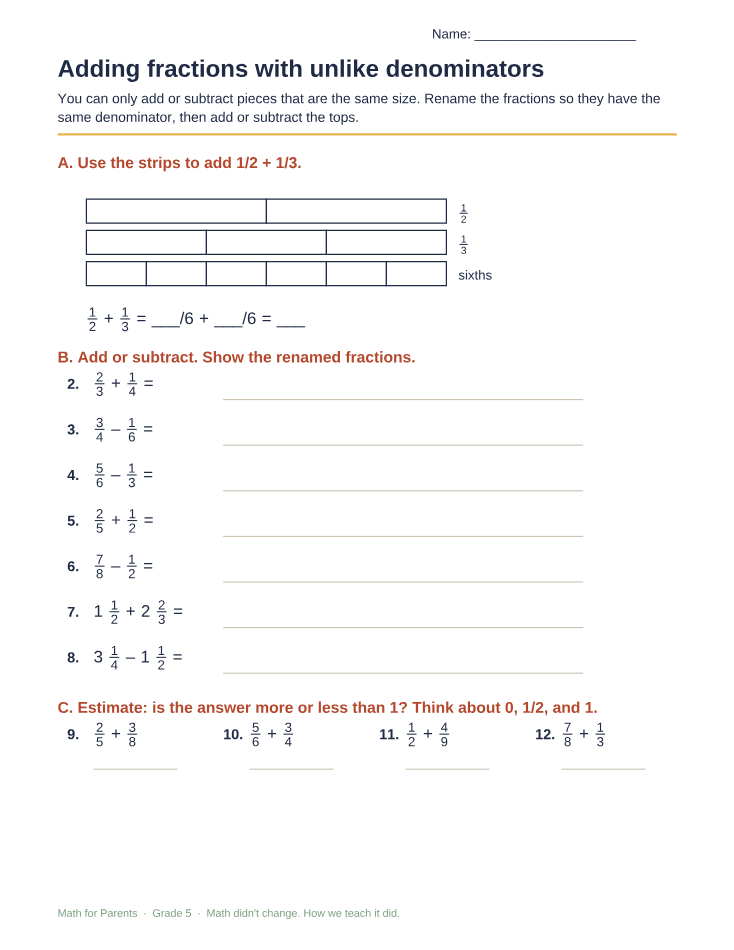
To add or subtract fractions with different denominators, kids rename them so the pieces are the same size. 1/2 + 1/3 becomes 3/6 + 2/6, which is 5/6. Fraction strips or drawings show why the renamed fractions are equal.

How you probably learned it
You probably learned to find the least common denominator, multiply the top and bottom, and add, usually without pictures.
How your kid is learning it
Your kid starts with pictures: a strip cut in halves and a strip cut in thirds don't line up, but both line up with sixths. Any common denominator works (twelfths would too), so kids don't have to find the smallest one.
Why you can't add the tops and the bottoms
1/2 + 1/3 is not 2/5. Two fifths is less than a half, but we started with a half and added more. Kids learn to check answers with this kind of reasoning.
Mixed numbers
For 1 1/2 + 2 2/3, rename the fractions (1 3/6 + 2 4/6), add the whole numbers and the fractions (3 7/6), then trade 6/6 for 1 whole: 4 1/6.
Estimating with benchmarks
Kids compare fractions to 0, 1/2, and 1 to estimate. In 2/5 + 3/8, both fractions are a little less than 1/2, so the answer is a little less than 1.