What is the area model for multiplication?
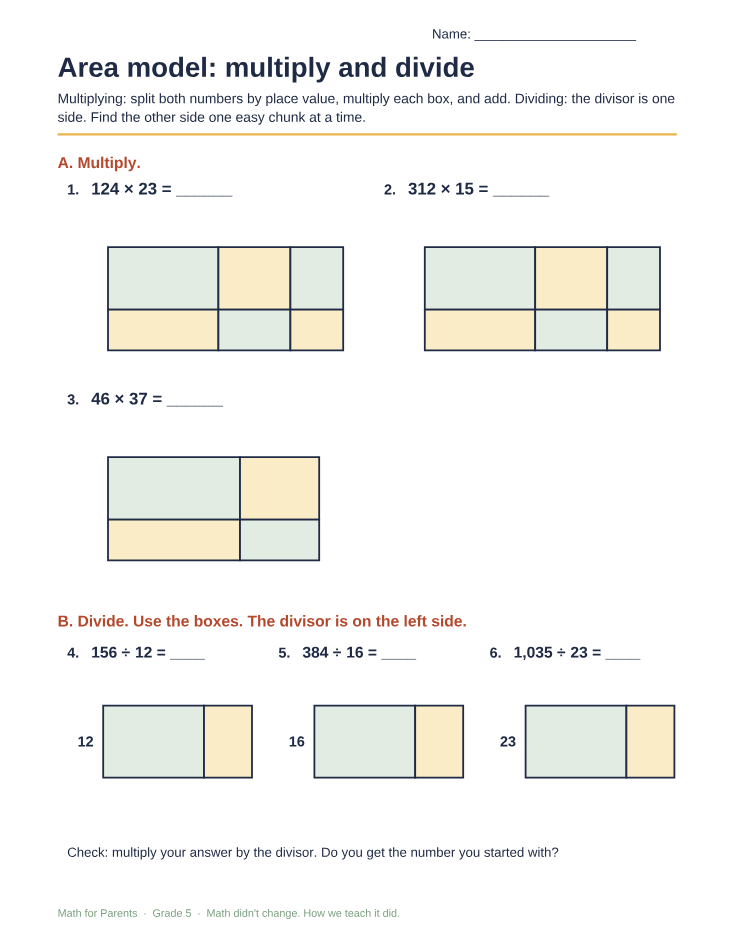
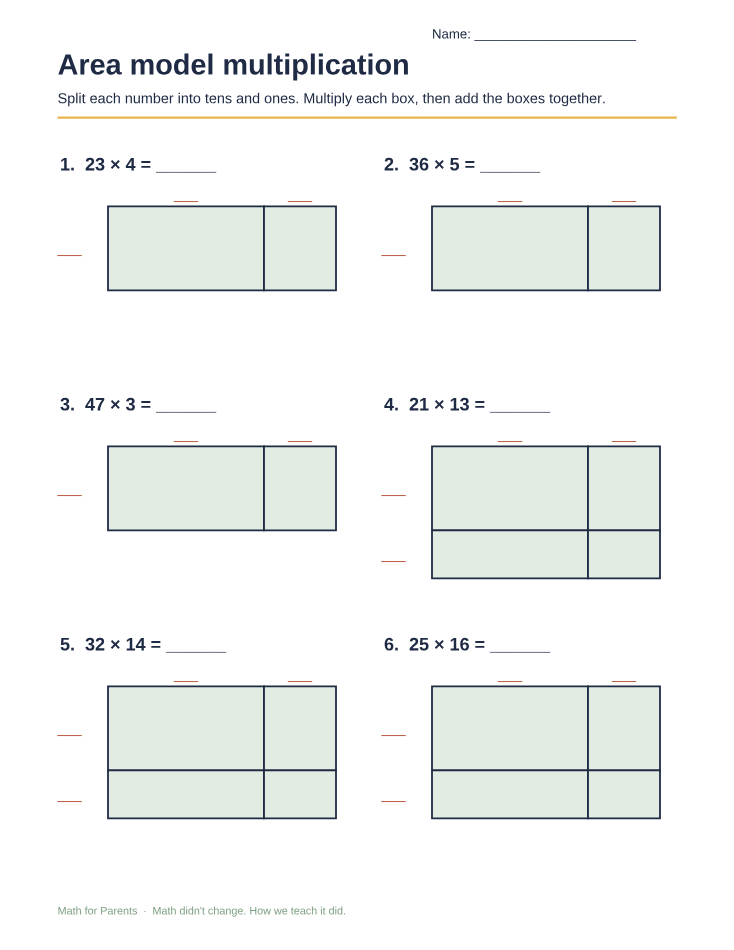
The area model is a way to multiply by drawing a rectangle, splitting each number into tens and ones, and multiplying the smaller pieces. Adding the pieces gives the answer, so 23 × 14 becomes 200 + 30 + 80 + 12 = 322.

How you probably learned it
You multiplied 23 × 14 by stacking the numbers, multiplying 4 × 23, then adding a zero and multiplying 1 × 23, then adding the rows.
How your kid is learning it
Your kid splits 23 into 20 + 3 and 14 into 10 + 4, draws a box for each pair, and multiplies: 20 × 10, 3 × 10, 20 × 4, 3 × 4. Then they add the four boxes.
Why it works
It is the same math you did, just with every step visible. Your old method also multiplied tens and ones separately. The area model draws each piece so nothing gets lost when "carrying".
23 × 14 = ?
Tap a box to multiply that part. Add the parts to get the answer.
Dividing with an area model
In 4th and 5th grade the area model also works backward, for division. For 156 ÷ 12, draw a rectangle with one side of 12 and an area of 156. Take out an easy chunk (12 × 10 = 120), see what is left (36, which is 12 × 3), and add the side lengths: 10 + 3 = 13.
Where it leads
By 5th grade most kids move to the standard method you know. The area model makes that method make sense, and it comes back later for multiplying fractions and in algebra.